Discovery
Discovery is the Media Ratings Terminal (MRT) workspace for vetting supply at scale. It gives you a filtered, searchable view of millions of mobile apps, CTV apps and websites, with privacy, compliance, risk, traffic and brand safety signals in one place. Use it to build an exclusion list before a campaign, vet a new publisher, or check a list of your existing supply.
To open it, sign in at ratings.pixalate.com and select Discovery.
Video (1.5 min): find and filter supply in Discovery, then export the list.
Choose a channel

Discovery has three workspaces. They share the same filters and export workflow, so you can apply the same vetting standards to each.
Set device and region
Discovery reports data separately for each device type and region. If you leave these broad, you get several rows for the same app or domain, one for each device and region combination, plus one for all data. To get one row per app or domain, choose a single device option and a single region.
Device
All Devices reports all of Pixalate’s data for the app or domain in one row, whatever device it was seen on. For websites, All Devices also includes data that the other options leave out, such as CTV traffic and traffic from unknown devices.
For websites, an Include Subdomains toggle next to the region menu (off by default) includes subdomains in the results.
Region
The region options, for apps and websites, are:
Websites use the same five regions as apps: GLOBAL, APAC, EMEA, LATAM and North America. Choose GLOBAL to cover all regions.
Which settings to choose
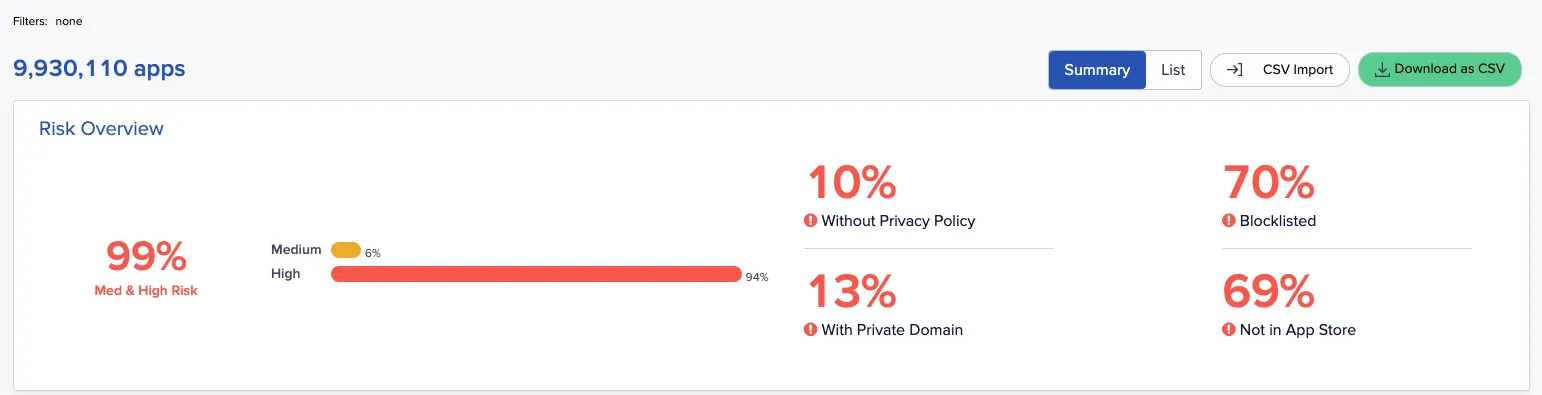
Match the settings to your media buy. If your partners may deliver only to smartphones, or only in certain regions, those settings represent your buy most closely. Many buys don’t restrict device or location, and inventory providers can misrepresent devices, so All Devices and the GLOBAL region give the most complete view of risk.
When you upload a list, each device and region combination returned is a separate result, and results count toward your quota. Choosing All and GLOBAL keeps the number of results down. See Quota and usage.
Filter the results
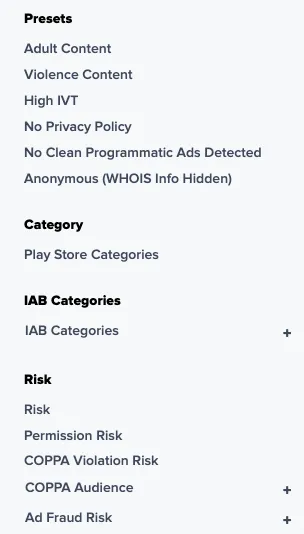
The filter panel on the left is where most vetting happens. You can filter on hundreds of metrics, grouped into these categories:
- Risk and IVT. The overall risk rating (Low, Medium or High) is a composite score based on programmatic transaction data, invalid traffic (IVT) rates, ad viewability, registration data, app store data, authorized sellers, brand safety information and more. Filter on the composite rating or on individual IVT signals.
- Brand safety. Separate filters for each advisory category: adult content, gambling, violence, offensive content, hate speech, and alcohol or drug content. Use them to match a specific advertiser’s requirements rather than one blanket threshold.
- Compliance. COPPA violation risk rating, COPPA audience assessment (child-directed or general audience), privacy policy, terms and conditions, app-ads.txt or ads.txt, and age gate detection.
- Made for advertising (MFA). A Made for Advertising (MFA) group with an MFA Risk filter (low, medium or high, one level at a time) and an MFA Risk column in the results. For websites the group also has Ad Refresh Rate, Ad Density, Social Traffic Rate and Paid Traffic Rate filters; mobile apps have MFA Risk and Ad Refresh Rate. See Find MFA sites and apps in the MRT.
- Traffic and audience. Daily and monthly active users, inventory volume, download ranges, average user rating, content rating and top device type.
- Supply chain. Trusted seller, app-ads.txt or ads.txt, and owner domain. For websites, Owner Domain, Family of Sites and Registrant Email are under Publisher > Publisher Details. The owner domain filter finds every property owned by one business; see Find properties by owner.
CTV spoofing toggle
For CTV apps, the Include Spoofing toggle at the top is off by default. Turning it on includes spoofed inventory, so the results list many more apps and each app’s IVT figures change. Compare the two views to see whether an app’s risk comes from its own traffic or from spoofing of its bundle ID. See App spoofing.
Upload your own list
Instead of filtering the whole index, you can upload a CSV of bundle IDs (mobile or CTV) or domains (websites). The MRT looks up each one and returns a row of data for every property it finds. You can then apply the full filter panel to your list alone, for example to check one partner’s portfolio. See Check many apps or domains at once.
Export the results
Download the filtered results as a CSV and share them with partners or load them into your own systems. To build a block or target list step by step, see Build exclusion and inclusion lists.
The export columns for each channel are listed below. For full metric definitions, see the Glossary.
Mobile apps: CSV columns
Websites: CSV columns
CTV apps: CSV columns
Related
- Search: find a single app or domain quickly.
- Read an Insights report: the full detail page for one property.
- MRT FAQ: common questions about MRT data.
- Enrichment API: get the same data from code, with
regionanddeviceparameters.
Questions? Email support@pixalate.com.